
About the Greenpoint Energy Center Former MGP Site
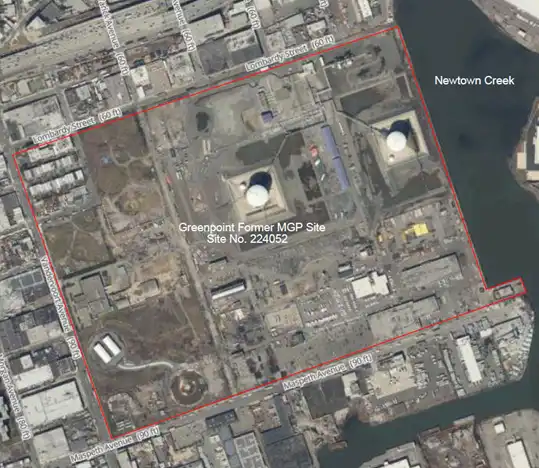
Prior to the development of the property as an MGP, the Site contained two other industries in the mid-1800s. Peter Cooper, a major New York industrialist, built a glue factory on Maspeth Avenue near Newtown Creek in 1880. The Peter Cooper Glue Factory was noted to be the largest in the country in the mid-1800s and ceased operations around 1915. To the north of the glue factory was the Demuth Glass Manufacturing Company near Lombardy Street and Newtown Creek which operated from approximately 1870 to 1921. The Aetna Varnish company was located on the southwest corner of the property near the intersection of Maspeth and Vandervoort Avenues and operated from approximately 1920 to 1951.
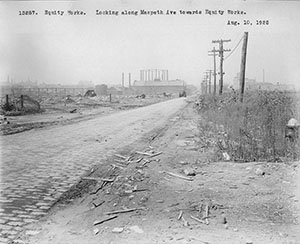 The Site was owned and operated by Brooklyn Union Gas (BUG), through most of the 20th century, except for a period of years (1928–1930) when the gas plant was built and directly owned and operated by Koppers. Gas was manufactured at the Site over an approximate 40- year period between 1927 and 1968. During that time, gas was made using varying processes including carbureted water gas, coke oven gas, and oil gas in different time frames and stages. Construction started on the water gas plant in 1925 and by 1927 the plant was operational, as was the first of two large, waterless (tar-seal) gas holders in the southwest corner of the Site. This distribution gas holder and a second holder built in 1949 made up what was called the Maspeth Station. The water gas plant included a boiler house separate from the generator house. Coal that provided fuel for the water gas generators was brought in by ships that were docked along the Site’s loading platform on Newtown Creek. A coal and coke storage yard separated the gas generator building from the Creek by a distance of over 625 feet. The relief holder for the water gas plant was located directly to the west of the generator house. The purifiers were situated well to the west of the generator house on the other side of Varick Avenue along? a plant road that ran north to south through the center of the Site. Oil tanks were located on Varick Avenue.
A year after the water gas plant was built the Koppers gas plant was built and operational. The Koppers gas plant was adjacent to and south of the water gas plant. An associated by-product plant was located close to Maspeth Avenue. The gas plant had two batteries of 25 ovens each along with all the ancillary facilities such as a quenching tower, gas coolers, gas scrubbers, a coke sizing mill, and related facilities. The gas works at the Site remained with the same configuration until a light oil plant was built adjacent to and west of the byproduct plant in 1941 at the start of World War II. As with other light oil plants around the country at the time, it produced ingredients for the manufacture of munitions. The light oil and by-products plants remained at the Site until 1952 when the coke plant was decommissioned. After 1950 with the introduction of natural gas and liquified natural gas (LNG), manufactured gas production declined and the MGP facilities were decommissioned between 1952 and 1977. The Department of Public Service reports for Brooklyn Union Gas from 1953 through 1968 state that liquid petroleum (LP), oil gas and refinery gas were “for standby purposes.” The production quantities listed in the Public Service reports do not indicate use of the MGP facilities for base load. The refinery gas process was retired in 1960 and only the oil gas and LP air processes were still in use through 1968. By the late 1960s, LNG was stored at the Site and in the mid-1970s a modern Substitute Natural Gas (SNG) plant was built. The SNG was used for base load conditions. It operated for approximately 12 years before closure in 1985. The LNG facility continues to distribute natural gas to the New York City metropolitan area, particularly during periods of peak demand, and the Site is used as a major regional regulator station for the natural gas network.
The RI was performed pursuant to a Multi-Site Order on Consent and Administrative Settlement, Index #A2-0552-0606, executed on February 22, 2007 and modified on August 10, 2007, between BUG (now d/b/a National Grid NY) and the New York State Department of Environmental Conservation (NYSDEC). The RI was performed to identify potential sources of environmental impacts, delineate the associated extent of impacts, determine the surface and subsurface conditions in the area of the Site, and evaluate potential off-Site migration pathways and their potential contributions to media and receptors. The results from the RI are appropriate to assess the potential for exposure to constituents present in impacted soils, groundwater, soil vapor, and indoor air. Under current conditions, complete exposure pathways to impacted surface soil potentially exist for outdoor workers or visitors in the western portion of the Site, so direct contact with soil in this area should be avoided. Access to the Site is restricted by fencing and security, and visitation to these areas does not occur frequently. There are no other known complete exposure pathways for potential receptors in other areas of the Site because of the existing structures and surface cover (concrete or asphalt), current use, and activities at the properties. Future construction workers who perform excavation work in areas on or adjacent to the Site may potentially be exposed to impacts in subsurface soil and groundwater. The potential construction worker pathway on-Site is currently addressed by an Interim Site Management Plan that prohibits subsurface work without the use of OSHA-trained personnel.